Ramesh Kumar from Greater Noida
Murphy is the name.
Tall. Slim. Male voice. Hair tied in a bun always. Lipstick, of course. In
summer, dark goggles. A lady's vanity bag hung on the shoulders.
Murphy was my neighbor
for 14 long years until I shifted out. I was on the third floor and Murphy was
one floor above. We met almost daily and exchanged greetings.
Yes, Murphy was
Transgender, living with an extended family, including a few goats, chicken,
and a dog on the exclusive terrace flat (barsati).
That was my close
encounter with transgenders. Barring my family, other flatmates kept a distance
from Murphy. Questions cropped up as to "how can you live in the same
building?" type. I ignored such questions.
On long road trips, I
came across them at most of the toll plazas where they beseech every single car
occupant for "help". Men had
curious looks and or some lewd comments while women rolled up car windows
fearing as if they were tsunami. Truck drivers by and large gave a few rupees.
Again, whenever I travel
in Chennai suburban trains, they board seeking alms. At times, passengers feel
peeved and raise alarm warranting police intervention.
They are part of our
society. Still, they are not because the majority of us have not accepted them
as fellow passengers on Planet Earth.
Denied of normal life,
ostracised by society, and bereft of a decent livelihood, they are compelled to
beg. Legislating to accept their gender in addition to male and female is fine.
But what matters is action on the ground. That's precise, Ashok Leyland is
attempting.'
The credit, on the
ground, goes to Mohammed Ali, National Head of Driver Training at the Hinduja
group company. Talking to this correspondent over the phone, Ali said that
during an interaction with his human resource head in the Chennai headquarters
of India's number two trucking company, the topic of roping in transgenders
cropped up.
"A few years ago,
we did train one transgender but that person did not pursue after getting the
driving license and we lost track. So, we have to start afresh," he avers.
Where there is a will,
there is a way. Tamilnadu perhaps has the unique distinction of holding Asia's
biggest festival to celebrate transgenders. It runs for 18 days where
transgenders congregate to get married symbolically with fun and frolic and on
the last day, embrace widowhood.
Transgenders marginally
by society and deprived any meaningful livelihood resort to begging and
prostitution. That's where the Ashok Leyland initiative to skill them as
drivers are laudable.
Over years, I keep
requests for women drivers for buses and trucks from CSR-serious corporate. How
far this Leyland move will be worth watching.
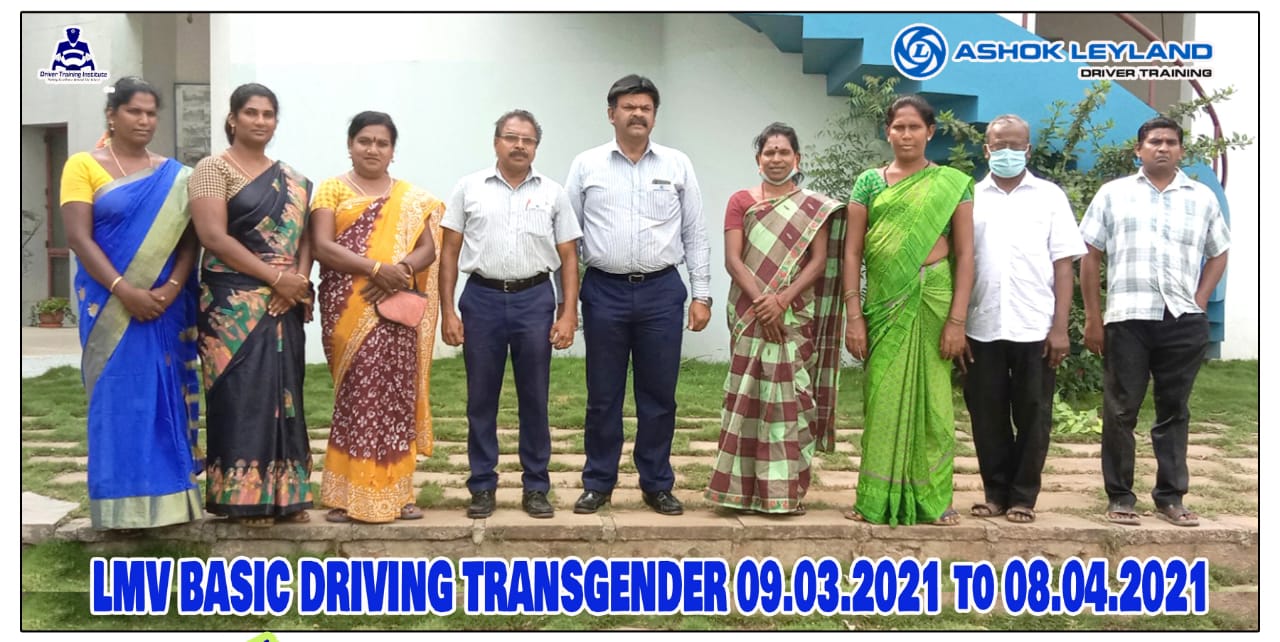
Of the three out of
eight transgender who has undergone training, certified, and received the
authentic Driving License is Manisha Agarwal, a qualified MCA. "This is a
good opportunity," Manisha exclaims during a telephonic chat with this
writer. Not to be ignored is her assertion that no job was offered though
Manisha was considered for Infotech jobs given her qualification.
Ali of Leyland, who
conceived and executed the project, concedes that the reception to absorb
transgender as drivers are mixed. "It is early days," he adds.
Meanwhile, he managed to get a job opening for one of the eight Transgender
drivers in the industrial town of Hosur, bordering Karnataka.
Suresh Babu, heading the
Driver Training Institute at Namakkal and who did the spadework to roll out
this initiative is confident of winning over the heart of transgender to join
the mainstream via Leyland. Cleverly, he made the first batch of transgender
drivers steer through the town roads in Namakkal during training and created an
awareness about their new role in society as drivers.
Manisha is hopeful of
her peers in the Transgender community would love to embrace driving as a
career option. "We have been talking to them about our expeirence in
learning a new skill and they are eager," she adds.
To cap it, Ali is
hopeful of convincing his top-brass at Leyland to absorb Manisha as one of his
institute's trainers at Namakkal.
Are these transgenders
ready for pan-India driving? Babu points out that currently they hold LMV
driving licenses and at the end of one year on the job training, they will be
ready for HMV. Valid point.
What about the
linguistic challenge of Hindi outside Tamilnadu? Manisha, a speaker of Hindi
thanks to her parentage and upbringing in Mumbai in childhood, says that she is
ready.
What about the reception
during the training at the institute? "Day one was a bit tough but
subsequently, all other male trainees understood us," adds Manisha.
Adds Babu: "The
curiosity value was definitely. Appreciation of our move followed. At the local
RTO office, these Transgender drivers were found to be 100% well trained."
Ali, meanwhile, is
exploring tapping the transgender community in other parts of India where it
has driver training schools set up with local government support to add the
depleting driving community, particularly in the trucking segment. If not the
long haul, at least these third gender, approved by Supreme Court and granted
equal status at least on paper, can address the shortage in the last mile
delivery.
Congrats, Ashok Leyland!
The writer is author of 10,000
KM on Indian Highways, co-founder of Transport Services P Ltd and Editor of
DRIVERS DUNIYA, an English Quarterly & Director-Producer of SAMACHAR SADAK
SE, a YouTube weekly program. Reachable at ramesh@konsultramesh.com